
 Flipkart
 Return Claims Management Services in India
ForceSight reconciles your Flipkart return, settlement and payout data to find cases that may be eligible for a return-related claim. Our specialists validate the evidence, file through Flipkart's process where it applies and track each approved amount to the payout that follows. Eligibility depends on Flipkart's current rules and the evidence you hold.
Use cases
Claim and reconciliation use cases on Flipkart
- Returns that Flipkart records with a quality or condition reason, where the warehouse receipt or QC note does not support Flipkart's reason. Whether a claim route exists depends on Flipkart's current policy.
- Returns recorded as delivered or in transit, where the seller's warehouse records show no receipt.
- Damaged or wrong-item returns, supported by QC notes and photographs.
- Payout shortfalls where the settlement is lower than order, return and commission data supports.
- Deductions in payout statements that cannot be traced to an order, return or agreed charge.
- Approved credits that have not yet appeared in a payout statement.
What we need
Data and evidence we need
- Access to Flipkart Seller Hub reports for orders, returns, payouts and deductions.
- Warehouse receipt and QC records for each return, with item and order IDs.
- Photographs and packing or unboxing evidence where Flipkart requires it.
- Return tracking numbers and courier delivery status.
- Purchase invoices and SKU cost data, used to value each claim.
- Payout statements and bank credit records, used to confirm each credit.
- A named approver and an agreed escalation contact.
How it works
Sample discrepancy-to-recovery workflow
Illustrative example only. The SKU, values and dates below are not real data.
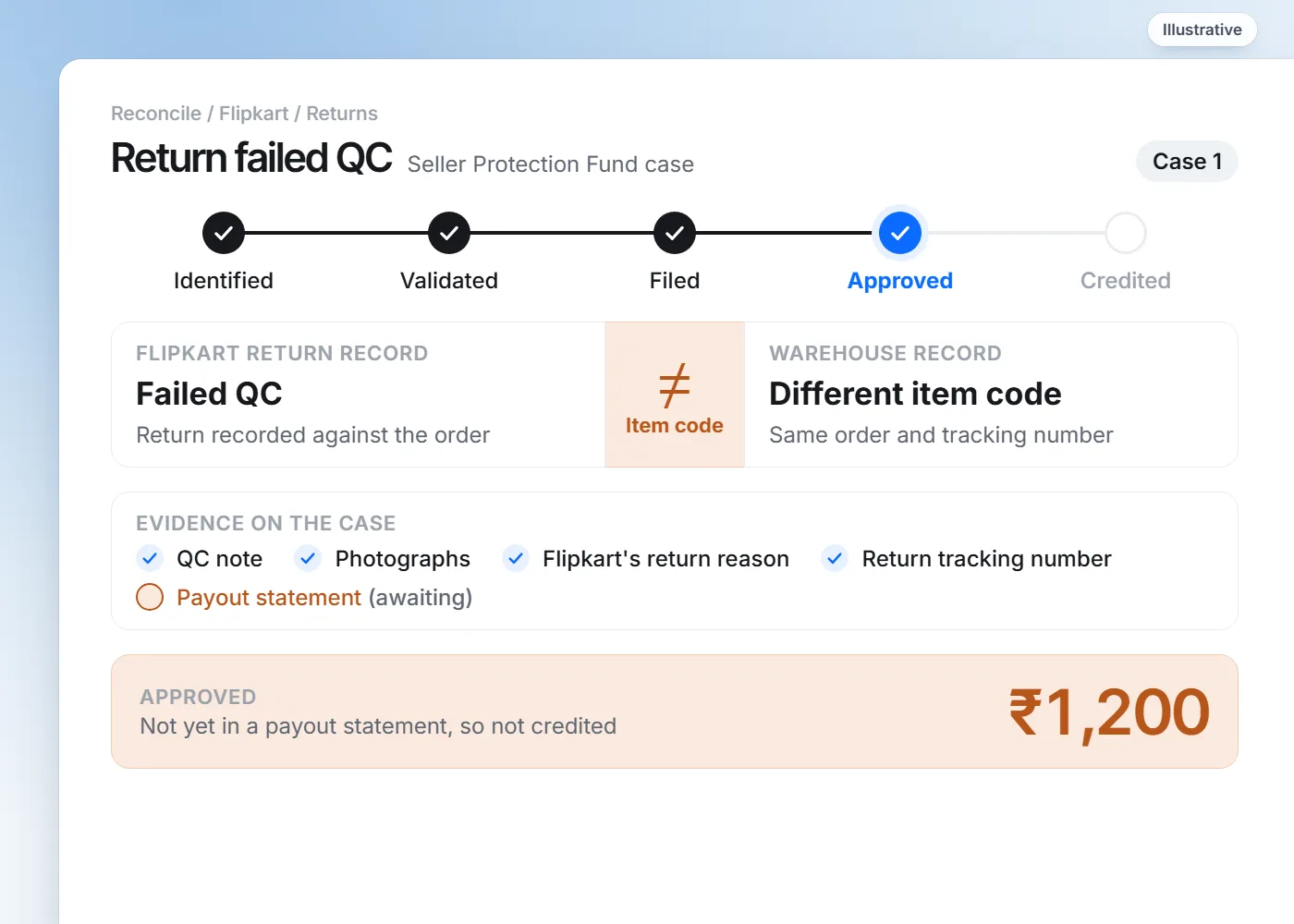
See the numbers as a table
| Line | Value |
|---|---|
| Flipkart return record | Failed QC |
| Warehouse record | Different item code, same order and tracking number |
| Stage | Approved |
| Approved, not yet in a payout statement | ₹1,200 |
| Credited | ₹0 |
| Evidence on file | QC note, photographs, Flipkart's return reason, return tracking number |
| Evidence awaiting | Payout statement |
1
Connect
- ForceSight pulls the illustrative period's return report, warehouse QC data and payout statement into one view. Access and reporting scope are agreed before any filing.
2
Reconcile
- An illustrative return is recorded by Flipkart as failed QC. The matching warehouse record shows a different item code for the same order and tracking number. The case is flagged as a candidate discrepancy.
3
Validate
- The specialist reviews the QC note, photographs and Flipkart's return reason. They check the claim route and the filing window. Illustrative value at cost: about ₹1,200, before review.
4
File & pursue
- The case is filed with the evidence through Flipkart's standard claim process. The specialist tracks the case status, answers Flipkart queries and reworks the case if it is rejected and the rejection is eligible for rework.
5
Verify credit
- The case is shown as approved when Flipkart accepts the amount. It is shown as credited only when the amount appears in a payout statement or bank record. Illustrative example: the approved amount is not yet in a payout, so it is held in the approved state.
Division of work
What ForceSight automates vs what the specialist handles
ForceSight automates
- Pulls return, payout and warehouse data from connected sources.
- Matches returns, tracking numbers, item IDs and payout lines to flag mismatches.
- Organizes exceptions by claim type, status and age.
- Assembles the supporting records for each candidate case.
- Tracks identified, validated, filed, approved and credited amounts as separate states.
The specialist handles
- Checks each candidate against Flipkart's current return and claim rules.
- Decides which candidate cases are valid and worth filing.
- Files, follows up and responds to Flipkart requests through Flipkart's standard claim process.
- Reworks rejected cases and escalates under the agreed rules.
- Confirms approved amounts against actual payout and bank credits.
Scope and limits
Eligible dispute types and limitations
- Return-related cases where the warehouse evidence supports a claim under Flipkart's current policy.
- Return-not-received cases where tracking and delivery records support the claim.
- Short payouts with a traceable, unexplained difference.
- Recovery depends on Flipkart's current policy, the seller agreement and the evidence. Not every return or deduction qualifies.
- Valid deductions remain payable. We record them and do not dispute them.
- Filing windows apply. We do not file a case we expect to fall outside its window.
- Without access to Seller Hub, we can reconcile your data but cannot file.
- Client approvals and evidence are still needed.
- Claims closed without reimbursement stay separate from money recovered.
- Recovery is not guaranteed. A claim can be rejected even when the evidence is complete.
ForceSight is an independent service provider. It is not affiliated with, endorsed by or sponsored by Flipkart. Flipkart is a trademark of its owner.
FAQ
Frequently asked questions
What are Flipkart return and seller-protection claims?
Flipkart calls its programme the Seller Protection Fund (SPF). It is designed to cover certain losses on returns, such as products that are damaged, different from what was shipped, or never received. Scope and eligibility follow Flipkart's current policy, and we confirm the route for each case before filing.
Which Flipkart returns can ForceSight review?
Returns that failed QC, returns not received, and damaged or wrong-item returns, where Flipkart's rules and your evidence allow a claim. Each case is checked before it is filed.
What evidence should our warehouse capture for each return?
Typically QC notes, item and order IDs, photographs, package images and courier tracking. Flipkart's requirements vary by claim type.
What happens if Flipkart rejects a claim?
Our specialist reviews the rejection reason, collects any missing records, reworks the case if it is eligible and escalates under the agreed rules.
Can ForceSight tell which Flipkart deductions are wrong?
Not automatically. We flag deductions that cannot be traced to an order, return or agreed charge. A specialist then decides whether each one is a valid dispute. Valid deductions stay payable.
How will we know a Flipkart claim has actually been paid?
We match approved amounts to Flipkart payout statements and bank credits. An approval alone is not reported as credited.
What access do you need to our Flipkart seller account?
The access needed for reporting and for filing is agreed during scoping. Your team may need to grant the permissions and confirm the account contact.
Managed reconciliation & claims recovery
Find out which Flipkart cases are worth filing
Schedule a CallShare your return volumes, payout statements and open claim backlog. We will review where managed claims can reduce the workload on your finance and operations team.