
BigBasket
BigBasket Supplier Deduction and Short Payment Reconciliation for Brands
Supply to BigBasket can run under more than one arrangement, and each can settle differently. ForceSight keeps records for each arrangement apart before matching invoices, GRNs, debit notes and payment advice, so only eligible exceptions reach the claim queue.
Use cases
Claim and reconciliation use cases on BigBasket
- Supply-model separation: tagging each order, invoice and settlement by the supply arrangement in your contract before any matching, so a deduction is checked against the right rules.
- PO to invoice to GRN matching: quantity and rate differences on B2B purchase orders.
- Shortages and debit notes: shortages recorded at receiving, and the debit notes raised for them.
- Short or partial payments: a payment advice that nets off deductions the GRN and PO do not support.
- Claims and reversals: deductions later reversed or approved that have not been reflected in a payment.
- Sale-or-return and consignment-type flows: kept apart from purchase shortages, where they apply.
- Offsets in payouts: charges netted against a payout, checked against the agreed terms.
What we need
Data and evidence we need
- B2B purchase orders, invoices, GRN records and debit notes, with line-level quantities and rates
- Orders, invoices and settlement records for each supply arrangement, labelled by arrangement
- Payment advice and settlement statements mapped to invoice numbers
- SOR statements or stock movement records if the client sells on sale-or-return
- Receiving evidence for disputed lines, such as count sheets, photos or receipt records
- The supply agreement and rate schedule that set deduction rules
- Portal access and named approvers if we are filing on the client's behalf
Client approval is needed before any case is filed. Evidence availability for each claim type is confirmed during scoping.
How it works
Sample discrepancy-to-recovery workflow
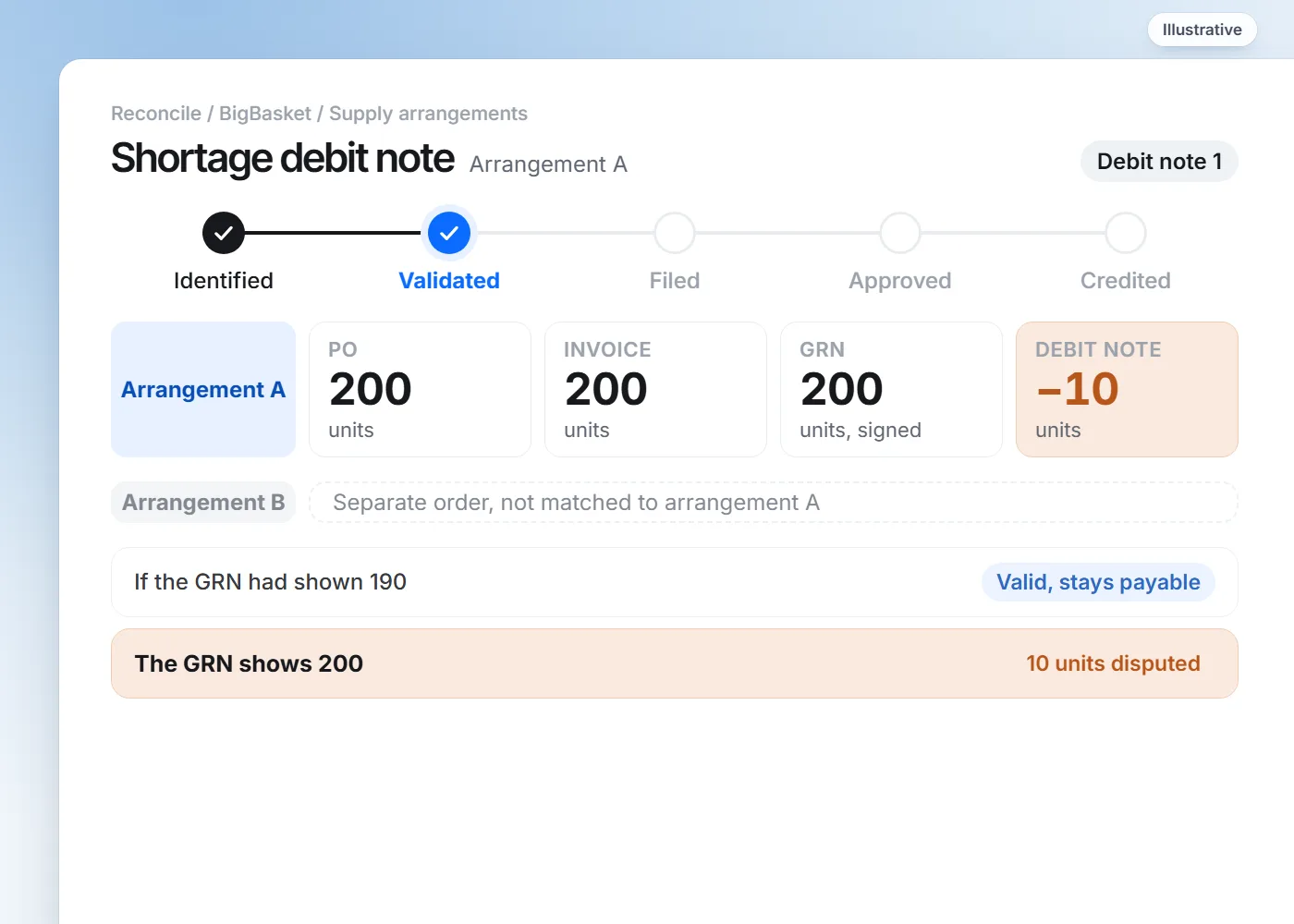
Illustrative example. Quantities only, no real amounts.
See the numbers as a table
| Arrangement A | Units |
|---|---|
| PO | 200 |
| Invoice | 200 |
| GRN, signed | 200 |
| Debit note, shortage | 10 |
| If the GRN had shown 190 | Valid, stays payable |
| The GRN shows 200 | 10 units disputed |
| Arrangement B | Separate order, not matched to arrangement A |
1
Connect:
- A PO for 200 units and its invoice are loaded and tagged as arrangement A. A separate order under another arrangement is tagged arrangement B. The two are not matched to each other.
2
Reconcile:
- The GRN for that invoice shows 200 units received. A debit note deducts 10 units as a shortage. Matching flags the deduction as conflicting with the GRN.
3
Validate:
- The team checks the signed GRN, the PO and the supply terms. If the GRN had shown 190 units, the deduction would be valid and would stay payable and recorded. Because the GRN shows 200, the 10 units become a dispute candidate.
4
File & pursue:
- The case file (PO, invoice, GRN, debit note and payment advice) is submitted through the route BigBasket provides for your account. The team responds to queries and escalates through your own BigBasket contact if there is no reply.
5
Verify credit:
- The reversal is matched to the next payment advice. The ledger shows the case as filed until a credit appears, and only then as credited.
Division of work
What ForceSight automates vs what the specialist handles
ForceSight automates
- Tagging records by supply arrangement (for example purchase order or sale-or-return) where the client's data allows it
- Line-level matching of PO, invoice, GRN and payment advice within each supply model
- Grouping exceptions by reason and by supply model
- Preparing case files and ledger entries for review
The specialist handles
- Deciding which supply model and settlement rules apply to an exception
- Confirming which exceptions are valid and commercially actionable
- Keeping valid deductions payable and recorded
- Filing, following up, responding to queries, reworking and escalating cases
- Matching approved and reversed amounts to payment advice and settlement records
AI assists with categorisation and case preparation. Specialists remain responsible for validation, filing and escalation.
Scope and limits
Eligible dispute types and limitations
- Invoices short-paid where the GRN and PO contradict the deduction
- Debit notes raised without GRN or PO support
- Approved reversals that have not reached a payment
- Valid deductions remain payable or recorded. We do not dispute them.
- Items under different supply arrangements are disputed under their own settlement rules. An exception is not moved from one arrangement to another.
- Sales outside your supply agreement with BigBasket are outside this page's scope unless the agreed scope covers them.
- Not every open invoice or deduction is recoverable. Recoverability depends on contract terms, evidence and the filing window.
- Reporting keeps identified, validated, filed, approved and credited amounts separate. A closed ticket without a credit is not counted as recovered.
- Recovery is not guaranteed. A claim can be rejected even when the evidence is complete.
ForceSight is an independent service provider. It is not affiliated with, endorsed by or sponsored by BigBasket. BigBasket is a trademark of its owner.
FAQ
Frequently asked questions
Do you treat every BigBasket supply arrangement the same way?
No. We tag each record by supply arrangement first and then match it against that arrangement's rules. Two deductions can look alike but need different evidence and different settlement checks.
Can you reconcile sales outside your supply agreement?
Only where the agreed scope and data access cover it.
Which BigBasket deductions are valid?
Deductions that match the PO, GRN, invoice and the agreed rate schedule stay payable and are recorded. We flag exceptions only where the records contradict the deduction.
What about sale-or-return stock?
SOR stock follows its own settlement logic and is not treated as a purchase shortage. We confirm during scoping whether SOR applies to your account.
Who can raise the dispute with BigBasket?
That depends on who holds the supplier relationship and portal rights. For accounts where you grant access, our team prepares and submits cases, follows up and handles rework.
How do you show what was actually recovered?
Credits are matched to payment advice or settlement statements. Approved amounts and actual credits are reported separately. A closed ticket without a credit is not counted as recovered.
What information do you need to start?
Order, invoice, GRN, debit note and payment advice extracts for each supply arrangement, for an agreed period, plus portal access and named approvers. Exact requirements vary by claim type.
Managed reconciliation & claims recovery
Separate the B2B from the direct, then check what is owed
Schedule a CallShare a sample of your supply records. We will review which deductions are valid and which exceptions may be worth a dispute.