
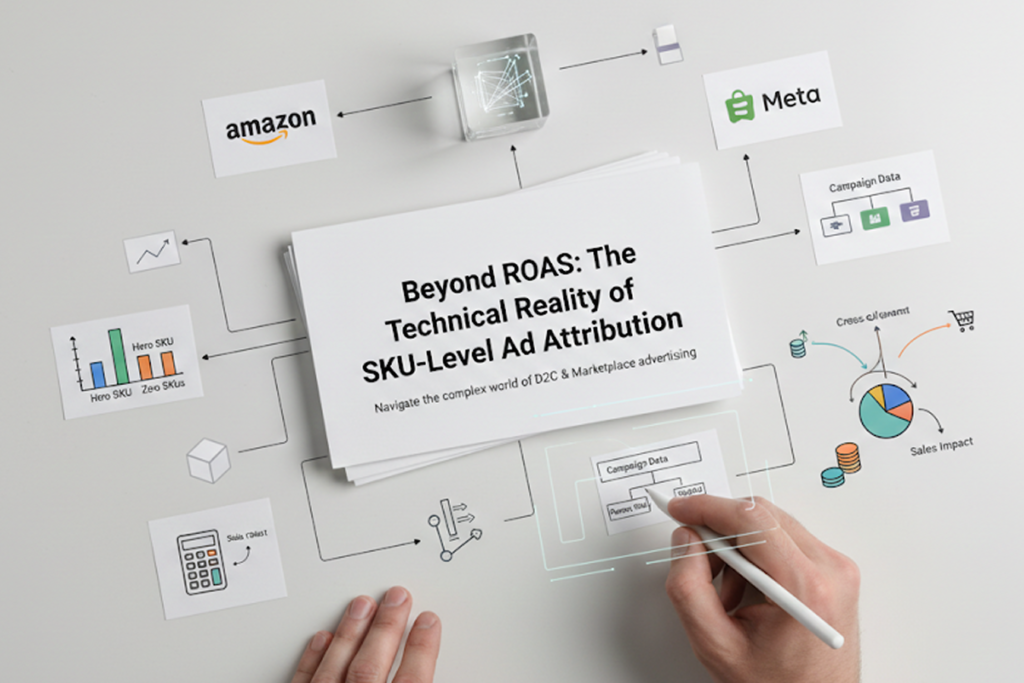
Beyond ROAS: The Technical Reality of SKU-Level Ad Attribution
In the modern D2C and Marketplace ecosystem, "Ad Spend" is no longer a simple line item; it is a complex variable that behaves differently across every channel and every SKU. For a brand operating across 12+ platforms (Amazon, Flipkart, Shopify, Blinkit, etc.) with 500+ SKUs, the standard approach to ad budgeting is often fundamentally flawed. The industry standard is to measure performance at a Campaign Level. While this provides a macro view of efficiency, it creates a "Black Box" at the unit economic level.
The Technical Blind Spot: Campaign vs. Parent SKU
The core problem is data granularity. Most ad platforms (Meta, Amazon Ads, Google Ads) report spend primarily at the Account and Campaign levels. They do not naturally trickle this data down to the Parent SKU level.
This leads to three critical analytical failures:
1. The "Hero vs. Zero" Mask: A campaign might look profitable (high ROAS) on average. However, it is often driven by a few "Hero" SKUs masking the bleeding costs of "Zero" SKUs within the same ad set. Without SKU-level attribution, you cannot surgically cut inefficiencies.
2. The Parent SKU Aggregation Failure: For brands with variants (size, color), accurate analysis requires data aggregation at the Listing/Parent SKU level. Without this, ad costs often get arbitrarily loaded onto the first variant (e.g., "Small/Red") rather than the cluster, skewing the profitability analysis of the entire product line.
3. The Channel Margin Discrepancy: You cannot measure ad effectiveness in a vacuum. A 20% Ad Spend on Sales (ACOS) might be healthy for Shopify (where platform fees are low) but disastrous for Amazon (where commissions and logistics fees are high). Apples-to-apples comparison is impossible without integrating margin data.
The Solution: Algorithmic Allocation & Guardrails
At ForceSight, we move beyond simple reporting to meaningful ad attribution at a decision making level. We solve the "Method to the Madness" through three specific mechanisms:
1. The ForceSight Allocation Engine
We don't just aggregate data; we attribute it. ForceSight utilizes a proprietary Allocation Model to push every rupee of ad spend down to the lowest Parent SKU level.
- Direct Mapping: For SKU-specific campaigns, costs are programmed 1:1.
- Brand/Category Campaigns: For broad campaigns (e.g., “Summer Sale”), our engine allows flexible allocation keys. Brands can choose to distribute cost based on Net Revenue, Gross Quantities, or specific Landing Page SKUs.
- Attribution across channels is rarely linear. A significant portion of ‘Top of Funnel’ spend on Meta and Google often does not result in a direct Shopify conversion but instead drives traffic to Amazon or Flipkart, where customers prefer to buy. Without a unified view, brands often mistakenly cut ‘inefficient’ Meta ads, unaware that they are actually fueling their Marketplace velocity.
- Custom Logic: The model supports brand-specific custom allocation requests, ensuring that even the most complex cross-pollination strategies are reflected accurately in the P&L.
2. Profit-Contextualized Performance
Ad spend cannot be reviewed in isolation. It must be viewed through the lens of Net Margin. ForceSight integrates the ad allocation model directly with your unit economics. This creates a Single Source of Truth where you can view Ad Spend alongside COGS, Commissions, and Logistics.
3. The Rule-Based Engine (The Guardrails)
No two channels are the same. ForceSight replaces manual monitoring with a programmable Rule Engine. Brands can define "Best Case" and "Worst Case" target expectations by SKU, Category, or Channel.
Example Scenario:
- Rule A (Shopify): Max Ad Spend cap set at 25% of Sales.
- Rule B (Amazon): Max Ad Spend cap set at 10% of Sales (due to higher platform fees).
The system monitors these thresholds in real-time. If a breach occurs, or if a successful campaign runs out of budget, ForceSight triggers an instant notification detailing the exact INR overspend or opportunity loss. Crucially, this logic extends to Cross-Channel Mapping: the system correlates spend spikes on discovery platforms (like Meta) with sales velocity on marketplaces (like Amazon), ensuring you don't mistakenly cut a D2C ad that is silently fueling your B2B growth.
Summary
You cannot optimize what you cannot measure at the unit level. ForceSight transitions your finance function from "Campaign Guesswork" to "SKU-Level Precision," allowing you to allocate capital where it actually generates profit, not just revenue.
Take control of your Ad Efficiency. Visit forcesight.ai to learn more.